EN
EN

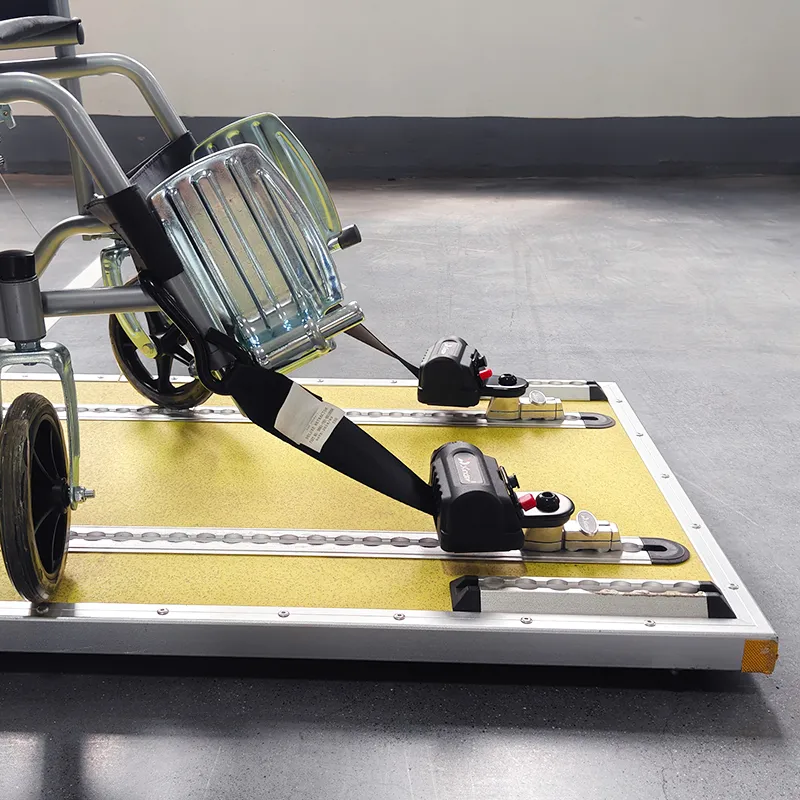
The Critical Role of Wheelchair Restraint in Preventing Transit Injuries
How wheelchair restraint prevents falls, tip-overs, and secondary impacts during sudden stops or collisions
A wheelchair restraint system functions as the primary barrier between a passenger and a violent ride. Its core job is to anchor the chair to the vehicle floor—preventing the uncontrolled movement that causes injury. During a sudden brake or sharp turn, an unsecured wheelchair becomes a rolling projectile. Even low-speed deceleration can tip it sideways or launch it forward into other passengers or interior surfaces. A properly installed 4-point tie-down system combats these forces at the frame level, locking the chair’s mass to the vehicle’s structure and stopping the initial slide or tip-over. This ground-level securement is the first line of defense—and it works only when paired with an occupant restraint. Without it, the wheelchair itself becomes a source of secondary impact, striking the rider or others nearby. Zero movement of the base equals zero uncontrolled energy transfer.
Occupied vs. unoccupied securement: Why restraining the person and the chair is non-negotiable
Securing an empty wheelchair is a cargo task. Securing an occupied one is a life-safety protocol requiring two distinct, interdependent layers. The first layer—a 4-point tie-down—anchors the wheelchair frame to the vehicle floor. The second layer—a separate 3-point occupant restraint (lap and shoulder belt)—holds the passenger securely within the seat. Together, they form a validated Wheelchair Tie-Down and Occupant Restraint System (WTORS). Relying on just one layer creates critical failure modes: tie-down without occupant restraint risks ejection; occupant restraint without tie-down risks full-unit tip-over, turning the belt into a pendulum. Structural integrity matters too—attaching belts to armrests or footrests violates safety standards and compromises load paths. The chair must be anchored at its strongest, designated points, and the occupant must be held independently. This dual-system approach treats the chair and rider as a single integrated unit—one that must survive crash forces as one.
Wheelchair Restraint Systems: Meeting ADA Standards and Real-World Safety Demands
ADA-compliant wheelchair restraint requirements: What the law mandates—and why it’s the minimum
Under 49 CFR 38.23(d), all ADA-compliant buses and vans must provide a complete WTORS: a four-point tie-down anchoring the wheelchair to the vehicle floor, plus a separate lap-and-shoulder occupant restraint. Neither component replaces the other; both must be used together to meet the regulation. The tie-down system must comply with ANSI/RESNA WC-4:2017, which requires survival of a 30 mph, 20 g frontal crash pulse. Each tie-down assembly must have a minimum working load limit of 2,500 pounds, and straps must attach directly to the wheelchair frame—not wheels, casters, or removable parts. These rules establish the legal baseline, but real-world safety demands more than compliance: they demand correct installation, consistent use, and integration with WC19-compliant wheelchairs. A properly installed WTORS isn’t a checkbox—it’s the foundational safeguard against ejection and secondary impact.
Crash data insights: Injury patterns linked to inadequate or missing wheelchair restraint
When wheelchair restraint is absent or improperly applied, injury risk surges. A 2023 Transportation Safety Institute analysis found unrestrained wheelchair users are four times more likely to sustain severe injuries in a collision than those using a fully compliant WTORS. Common injury patterns include traumatic brain injury from head strikes against windows or seats, spinal fractures due to ejection or violent torso rotation, and lower-extremity fractures when the wheelchair becomes a projectile. Paratransit incidents also reveal how unsecured empty wheelchairs can tip over during sudden stops—striking other passengers and turning mobility equipment into hazards. These findings confirm that restraint systems, when correctly installed and used, prevent chair movement and keep occupants within the vehicle’s protective envelope—reducing the likelihood of life-altering harm.
Integrated Wheelchair Tie-Down and Occupant Restraint Systems (WTORS)
How WTORS unifies wheelchair securement and occupant protection into one validated safety protocol
WTORS is not two separate systems—it’s one integrated, performance-validated safety protocol. It combines a four-point tie-down (securing the wheelchair frame to the vehicle floor) with an occupant restraint (typically a lap-and-shoulder belt) to manage forces on both the device and the person. This dual function is grounded in ANSI/RESNA WC-4:2017, which mandates crashworthiness testing under a 30 mph, 20 g frontal impact. When paired with WC19-compliant wheelchairs—designed with reinforced, standardized tie-down attachment points and openings for routing occupant belts—the entire system forms a validated safety envelope. That integration ensures the chair doesn’t move and the occupant stays seated, replicating the protective performance of a standard automotive seatbelt system.
Vehicle-specific considerations: Installing and validating wheelchair restraint in vans, buses, and paratransit fleets
While 49 CFR 38.23(d) mandates WTORS across all ADA-compliant vehicles, effective implementation depends on vehicle type and configuration. In paratransit vans, floor anchor points must be reinforced and positioned precisely: rear anchors directly behind the wheelchair, front anchors slightly wider than the chair’s footprint—ensuring optimal strap geometry and preventing criss-crossing. Straps must attach exclusively to the wheelchair frame, never to wheels or detachable components. Larger transit buses require flexibility to accommodate varying wheelchair dimensions, often using adjustable or modular anchor systems. Compact, retractable designs suit smaller vans where space is constrained. Crucially, validation means more than installation—it requires crash-testing the full WTORS setup in the specific vehicle, confirming compliance with ANSI/RESNA WC-4:2017. Only then can operators trust the system to perform as intended in a real-world collision.
FAQ Section
What is the purpose of wheelchair restraint systems?
Wheelchair restraint systems prevent uncontrolled movement during transit, reducing the risk of falls, tip-overs, and secondary impacts during sudden stops or accidents.
Why is it important to secure both the wheelchair and the occupant?
Securing both ensures a complete safety protocol, combining tie-downs for stability and occupant restraints for protection. Failure to use both layers risks ejection or chair movement that can cause injury.
What are ADA standards for wheelchair restraint systems?
ADA standards, outlined in 49 CFR 38.23(d), mandate a four-point tie-down system and separate occupant restraint to ensure both the wheelchair and its user are securely anchored during transit.
How do crash tests validate the safety of wheelchair restraint systems?
Crash tests under ANSI/RESNA WC-4:2017 simulate conditions like a 30 mph frontal impact to ensure that both the wheelchair and occupant stay secured, meeting all safety requirements.