EN
EN

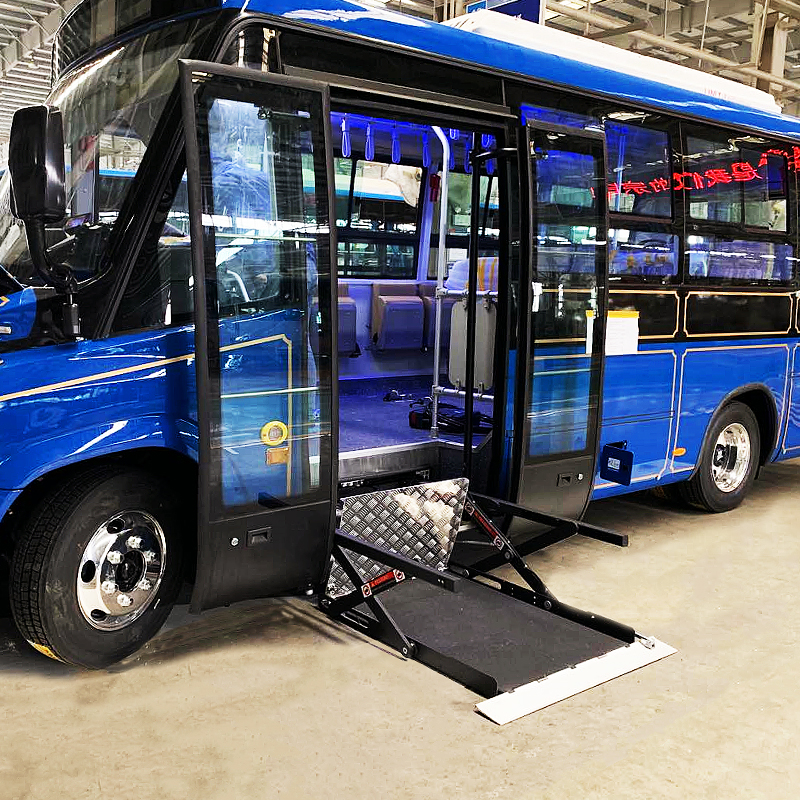
Federal Regulatory Foundation: ADA and DOT Rules for Bus Wheelchair Ramps
49 CFR Part 38.23(b)(1): Core Dimensions, Deployment, and Accessibility Mandates
The federal regulatory foundation for bus wheelchair ramps is codified in 49 CFR Part 38.23(b)(1)—the definitive technical standard enforced under the Americans with Disabilities Act (ADA) and administered by the Department of Transportation (DOT). This provision mandates a minimum clear width of 30 inches across the entire ramp surface to accommodate diverse wheelchair widths and allow stable maneuvering. Slope requirements are precisely calibrated: for vertical rises of 3 inches or less, the deployed ramp must not exceed a 1:4 slope; for rises greater than 3 inches, the maximum allowable slope tightens to 1:6, ensuring safe, independent boarding without excessive effort. These ratios reflect real-world curb heights and roadway variability—not theoretical ideals.
Ramps must be deployable and stowable by a single operator without excessive force, typically achieved through powered or spring-assisted mechanisms. Dual edge barriers—at least 2 inches high—must run continuously along both sides to prevent wheel runoff, and the surface must remain slip-resistant in all weather conditions. Structural components must support a minimum concentrated load of 600 pounds, verifying durability for modern power wheelchairs and their users. This load requirement applies to the ramp itself—not just the platform—and is verified through standardized engineering testing per industry best practices.
Scope Clarification: Public Transit, School Buses, and Private Contract Operators Under Parts 37 & 38
Compliance extends far beyond municipal transit fleets. Under 49 CFR Part 37, any entity providing “designated public transportation”—including fixed-route city buses, demand-responsive services, and school buses transporting students with disabilities—is subject to accessibility mandates. Part 38 supplies the enforceable vehicle design standards that Part 37 references and enforces. As a result, public transit agencies, school districts operating accessible vehicles, and private contractors delivering service under contract with public entities all fall squarely within scope. Even private charter operators may be covered if their service is open to the general public—though closed-door tours or purely private charters may qualify for limited exemptions. The unifying trigger is federal involvement: any operation receiving DOT grants, subsidies, or other federal financial assistance must comply with both Parts 37 and 38. Because the rules apply to vehicles purchased or leased after August 25, 1990, fleet renewal cycles serve as a natural compliance pathway. Enforcement tools—including withheld funding and civil penalties—underscore the legal weight behind these requirements, making verification of ramp dimensions, strength, and deployment safety non-negotiable for operators.
Physical Design Requirements for Bus Wheelchair Ramps
Physical design is where regulatory language meets real-world performance. While 49 CFR Part 38 sets the baseline, the 2010 ADA Standards for Accessible Design provide critical interpretive context—particularly on slope, platform geometry, and structural resilience. These are not advisory recommendations but legally enforceable specifications governing every new or retrofitted bus in covered service.
Slope, Rise, Landings, and the Enforceable 1:12 Ratio
A common point of confusion involves slope interpretation. Although Part 38.23(b)(1) permits steeper ratios (1:4 or 1:6) when deployed to variable-grade curbs or roadways, the enforceable running slope for the ramp’s primary boarding path is 1:12, consistent with the 2010 ADA Standards. This ratio ensures safe, self-propelled ascent for manual wheelchair users and reduces fatigue and instability for power chair operators. Cross slope—the side-to-side tilt of the ramp surface—must not exceed 1:48, preventing lateral tipping during transit. Equally important are level landings: a stable, flat transition zone—minimum 30 inches deep—at both top and bottom of the ramp eliminates hazardous grade breaks and supports secure wheelchair positioning before and after boarding.
Minimum Platform Size (30″ × 48″) and 600-Pound Structural Load Capacity
The ramp platform must provide unobstructed maneuvering space: a minimum clear dimension of 30 inches wide by 48 inches long. This accommodates the full footprint of most mobility devices—including wider bariatric and pediatric models—while allowing room for minor repositioning. Critically, the 600-pound load capacity applies to the entire ramp structure, not just the platform area. Engineering validation confirms this standard is essential for ramps exceeding 30 inches in length—ensuring no measurable deflection or deformation under repeated daily use. Manufacturers test to this threshold using dynamic loading protocols that simulate real-world boarding forces, including acceleration, vibration, and off-center weight distribution.
Operational Safety Protocols for Bus Wheelchair Ramp Deployment
Safety begins the moment the ramp deploys—and continues until it’s fully stowed. These operational safeguards go beyond dimensional compliance to address human factors, environmental variables, and system integration.
Automatic Leveling, Position Interlocks, and Anti-Slip Surface Requirements
Automatic leveling systems dynamically adjust ramp angle to match the gap between bus floor and landing surface—compensating for uneven curbs, snow buildup, or roadway settlement. Once fully extended, position interlocks engage automatically: they either lock the transmission or activate the parking brake, preventing accidental vehicle movement. A dashboard indicator light provides immediate visual confirmation to the operator—eliminating reliance on memory or verbal handoffs. The ramp surface must maintain a static coefficient of friction of at least 0.5, per ADA Accessibility Guidelines. This is reliably achieved through factory-applied grit-embedded coatings or precision-milled grooved treads—not aftermarket adhesives or temporary treatments. Daily inspections for wear, debris, oil residue, or corrosion are required maintenance steps—not optional checks—because traction loss poses immediate risk during boarding.
Integrated Accessibility: How Bus Wheelchair Ramps Interface with Securement Systems
True accessibility emerges not from isolated components, but from how the ramp connects seamlessly to the securement zone. Under ADA requirements, transit buses must provide at least two compliant securement spaces, and the boarding path must lead directly to them—without level changes, turns, or obstructions. A properly sloped ramp with a compliant landing enables smooth, straight-line entry into the securement station, whether it uses traditional four-point tiedowns or automated rear-facing systems.
Poor integration—such as misaligned ramp deployment or insufficient turning radius—forces awkward maneuvers that increase injury risk, as documented in transit surveillance studies conducted by the National Transit Database and the Rehabilitation Engineering Research Center on Mobility. Modern low-floor bus designs minimize this gap by aligning ramp deployment zones with securement stations, reducing driver intervention time and supporting rider independence. Automated securement systems further enhance this flow: telescoping arms guide the wheelchair into a padded, rear-facing station immediately after clearing the ramp—eliminating manual hook-and-belt attachment and the associated delays, privacy concerns, and physical strain. When ramp dimensions, landing geometry, and securement layout are engineered as a unified system—not sequential add-ons—accessibility becomes efficient, dignified, and genuinely inclusive.
FAQ Section
What are the slope requirements for bus wheelchair ramps?
The slope must not exceed 1:4 for vertical rises up to 3 inches, and must be 1:6 for rises greater than 3 inches. However, the primary boarding path's running slope must conform to a stricter 1:12 ratio.
How does the 600-pound load capacity for bus ramps apply?
The 600-pound load capacity applies to the entire ramp structure, ensuring no deflection or deformation under typical boarding and usage conditions.
Which entities need to comply with ADA ramp requirements?
Compliance is required for municipal transit fleets, school buses transporting students with disabilities, private contractors serving public entities, and any operation receiving federal funding through DOT grants.
What safety features are mandatory for ramp deployment?
Mandatory safety features include automatic leveling systems, position interlocks, and slip-resistant ramp surfaces with a minimum static coefficient of friction of 0.5.
How do wheelchair ramps integrate with securement systems?
Ramps must lead directly to securement zones without obstruction, enabling smooth entry. Modern designs incorporate features like telescoping arms and rear-facing padded securement stations for easier operation and independence.